
Species name: Muntiacus reevesi
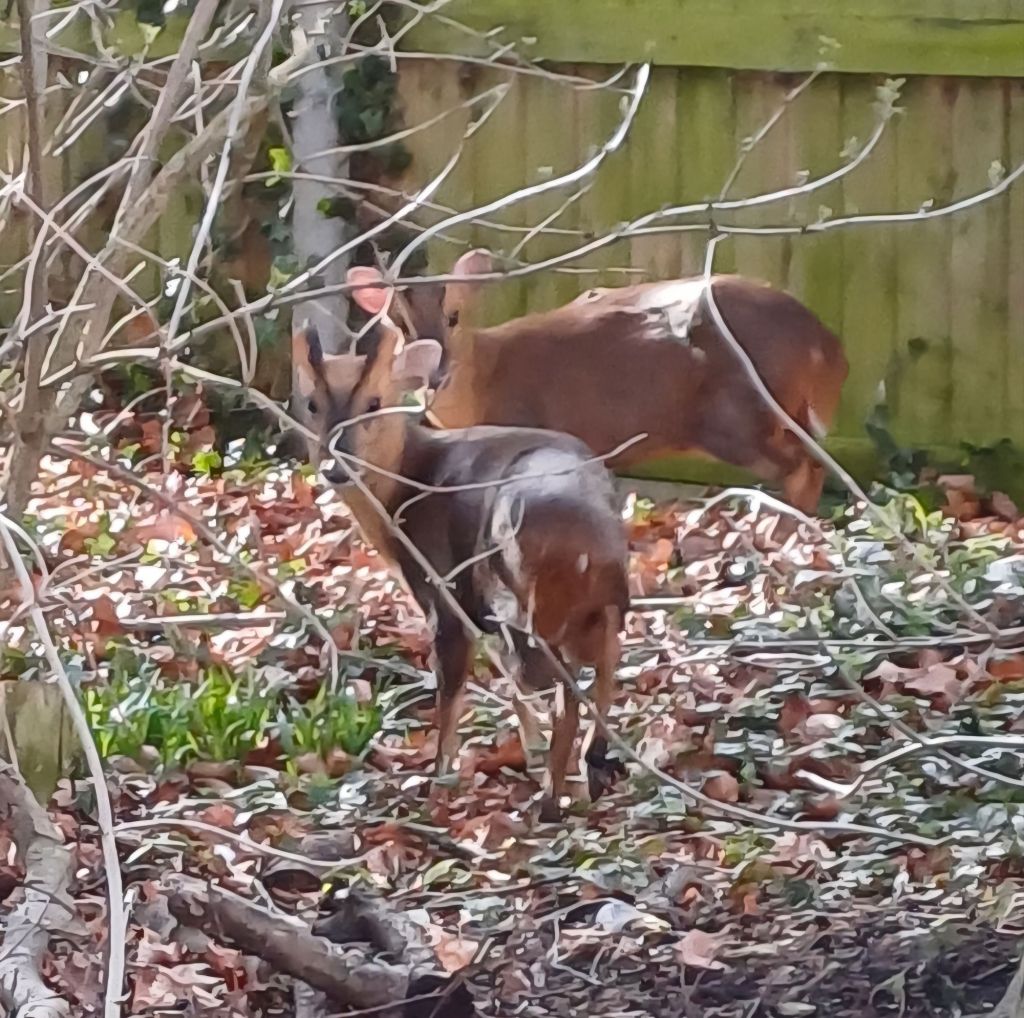
The Muntjac deer was first introduced to the UK at the start of the 20th century from China, leading it to now becoming a common deer species across southeast England, which means they are an invasive alien species. However, the Muntjac is a protected species in the UK, under the Deer Act 1991 (Wildlife Trusts, 2019)
They can be identified by their small body/height and its ginger/brown fur, alongside the dark stripes on their faces. Male muntjacs (bucks) are usually around 10-18kg, whereas females (does) weight around 9-16 kg. The Muntjacs sex can be identified through their heads, with bucks face being striped, with pronounced downward black lines, light coloured cheeks and large facial glands below the eyes, aswell has having antlers. Whereas does have no antlers and have a dark crown patch on their heads (British Deer Society, N/D).
Muntjac deers do not have specific breeding season, as they breed all year round, as well as being able to conceive again within days of giving birth, with does also able to start breeding at 7 months old. They are usually either found solitary, or in pairs, but pair-bonding (a strong, lifelong association between a mating pair) does not happen (British Deer Society, N/D).
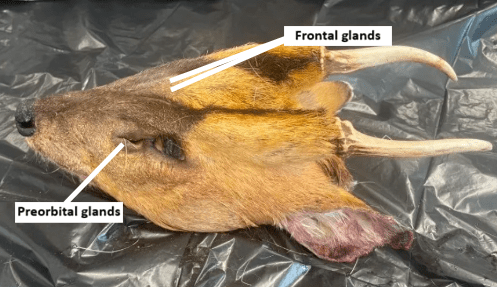
The facial glands found underneath bucks eyes can be seen on the photo above, they are prominent scent glands which are used for territorial marking and communication, such as during mating. They are muscularly controlled, so they can be pushed out, which leaves a potent chemical signal on plants when males rub their heads against them. They have two main sets, preorbital glands, which are in front of their eyes and the frontal glands, which are on the forehead and form a ‘V’ shape.
Muntjac deer often live in deciduous or coniferous forests, yet are often found in scrub, farmland and urban gardens. They are browsers, which means they eat a large variety of plants, such as tree shoots, leaves, berries, nuts, fungi, etc. This can be a problem, as it may stop certain trees or other plants from growing, as the deer eats the shoots, which can therefore lead to the decline of wildflowers and woodland growth, which will impact other species (Woodland trust, N/D). They are also most active at dawn and dusk, especially when there is little human activity.
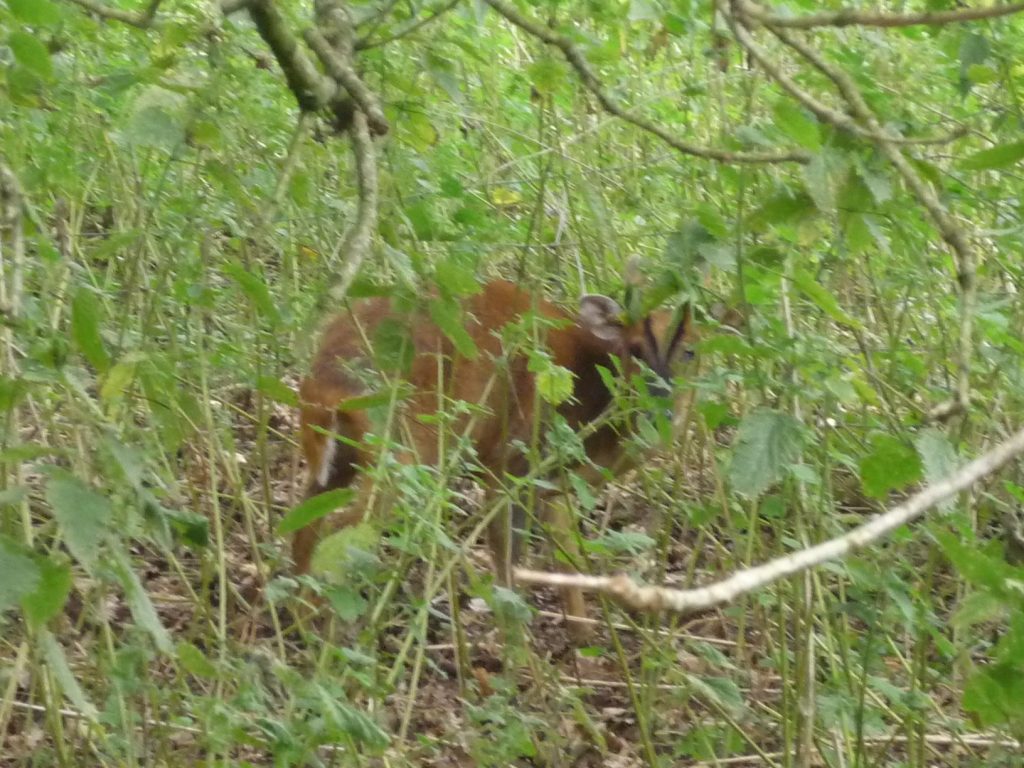
Despite being an invasive alien species, the muntjac do not cause a significant damage to the environment, apart from eating tree shoots, however due to their rapid increases in population, with an estimated 50k in the UK, it has led to an increase in deer vehicle collisions. It’s been estimated that muntjacs are involved in 25% of the deer vehicle collision England (British Deer Society, N/D).
They are also known as the ‘barking deer’, due to the loud bark the deer vocalises in different situation, they also scream when frightened, or in a dangerous situation.
Within folklore, the Muntjac deer is often linked to divinity, good fortune, wisdom and spiritual guidance in Asia. As well as this, in Buddhism, the muntjac is a companion to Ananda, which is a dispel of the Buddha, giving it a sacred connection.
References
“Muntjac Deer.” The British Deer Society, bds.org.uk/information-advice/about-deer/deer-species/muntjac-deer/. Accessed 7 Dec. 2025. N/D.
The Wildlife Trusts. “Muntjac Deer | the Wildlife Trusts.” Wildlifetrusts.org, 2019, http://www.wildlifetrusts.org/wildlife-explorer/mammals/muntjac-deer. Accessed 7 Dec. 2025.
Trust, Woodland. “Muntjac Deer (Muntiacus Reevesi).” Woodland Trust, http://www.woodlandtrust.org.uk/trees-woods-and-wildlife/animals/mammals/muntjac-deer/. Accessed 7 Dec. 2025. N/D.


Leave a Reply