
Species name: Macrolepiota procera
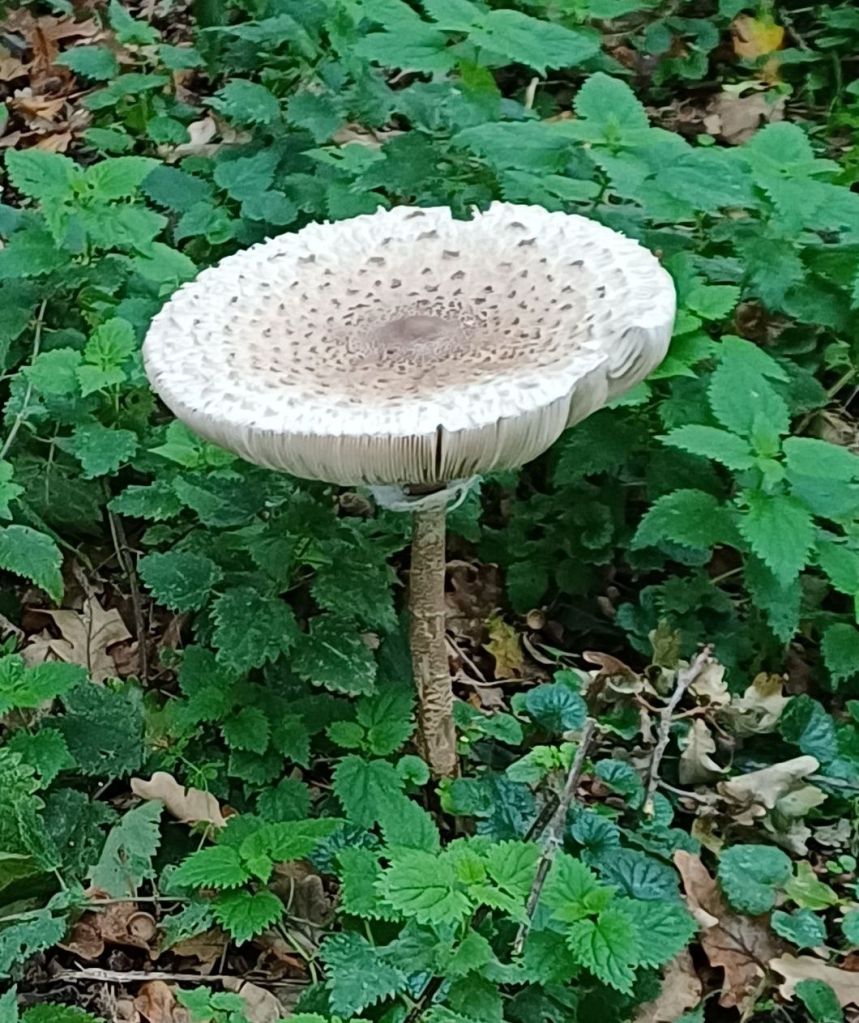
The parasol mushroom can grow up to 40cm tall, along with the cap width being up to 30cm. They can be identified by their large, flat cap once opened, which is scaly as the skin stretches as it grows. They have cream coloured gills, which are compact together. Their stems have a skirt on them, which on parasol mushrooms, is double and thick, which isn’t attached securely (Wild Food UK, 2017). The skirt is formed from a partiel viel, whilst the mushroom is first in development, and the edges of the cap are still connected to the stem, which help protects the gills whilst they are developing, and also protects the spores, which have a white print, whilst the mushroom in young. These partial viel rips once the mushroom is more developed, seperating the edges of the cap from the stem, which then formes the skirt.
They tend to be in season from June to September and are often found in open woods, amoungst ferns. The parasol mushroom which I found was alone, which can happen, but they often are found in rings (Wild Food UK, 2017). These rings are formed due to the way the Mycelium grows underground, which starts in a single point and grows outwards in a circular patern, as it searchs for more nutrience, which therefore leads to the fruting bodies appearing above ground in a circular ring (Woodland Trust, 2025).
The Parasol mushroom is part of the Agaricaceae family, which is a large and diverse group of saprotrophic fungi, which means its a decomposer, that feeds on dead organic matter. Other fungi apart of this family include, field mushrooms, button mushrooms and puffballs. These mushrooms are native to Europe and the United States, with them first being recorded in 1772, and given its genus in 1948 (Specialty produce, 2025).
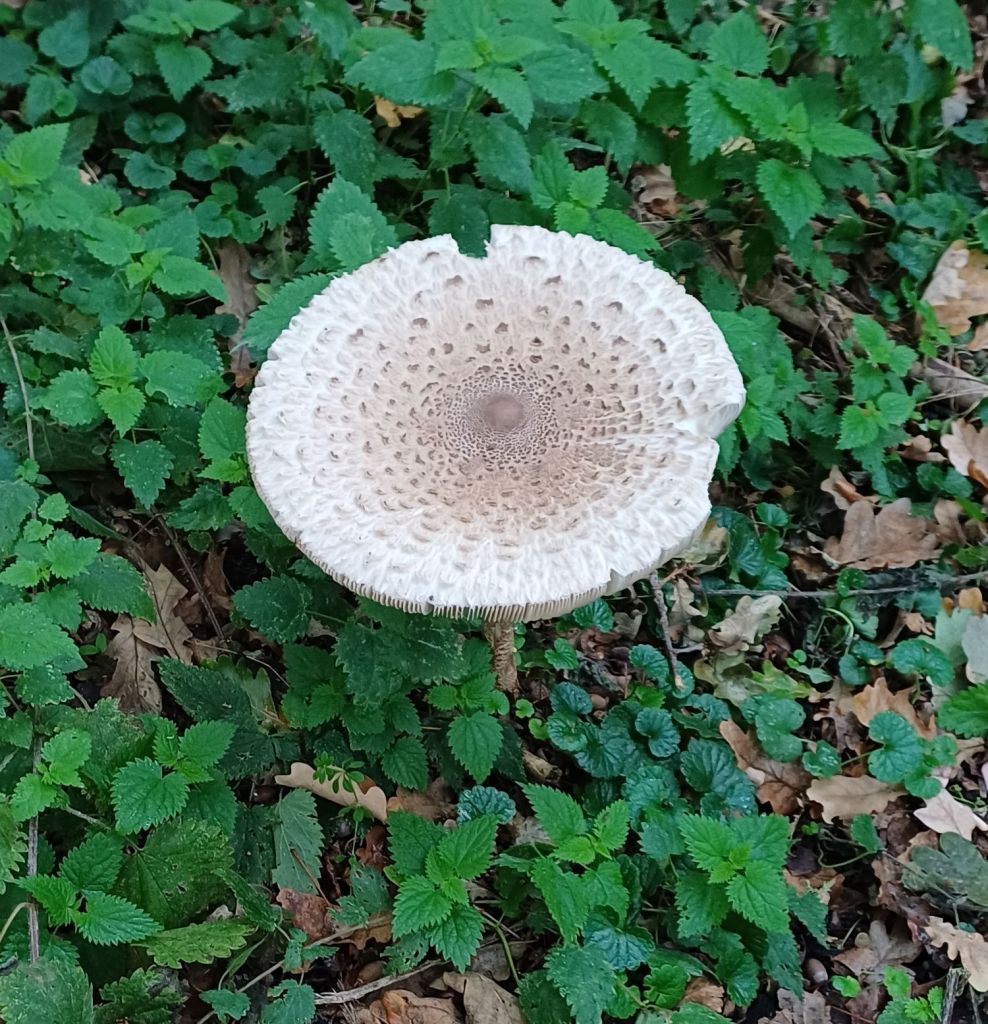
Parasol mushrooms are edible, and have good nutritional value, with it being a good source of vitamen D and B, as well as having a high source of potassium and being a good plant-based source of protein. Some cultures also believed that the parasol mushroom has medical properties, such as with digestive health (Charnwood foraging, 2024)
The folklore around parasol mushrooms links them to fairy rings, due to them often being found in rings, they are seen as a gateway to the fairy world, or areas where fairies, elves and witches would dance. Many cultures viewed these rings as dangerous, as if stepped into, it could lead to forced dancing, which would drive the person mad, or that it would lead the person to a young death, as they would either become invisible to the mortal world, or be taken to the fairy world (Woodland Trust, 2025).
Scotland and Wales also both have different folklore around the Parasol mushroom. With Scotland having a lejund saying that faries would use them as dinner tables and Wales having stories about faries using them as umbrellas (Specialty produce, 2025).
References
https://www.facebook.com/specialtyproduceapp. “Parasol Mushrooms.” Specialtyproduce.com, 2025, specialtyproduce.com/produce/Parasol_Mushrooms_15403.php. Accessed 5 Dec. 2025.
Parasol. “Parasol.” Wild Food UK, 27 June 2017, http://www.wildfooduk.com/mushroom-guide/parasol/. Accessed 5 Dec. 2025.
Richart, Jo. “Parasol (Macrolepiota Procera) | Charnwood Foraging.” Charnwood Foraging, 25 Dec. 2024, charnwoodforaging.co.uk/parasol-macrolepiota-procera/. Accessed 5 Dec. 2025.
Trust, Woodland. “Shaggy Parasol.” Woodland Trust, 2025, http://www.woodlandtrust.org.uk/trees-woods-and-wildlife/fungi-and-lichens/shaggy-parasol/. Accessed 5 Dec. 2025.
 Jorja's Ecology Blog
Leave a comment