
Species name: Pica pica
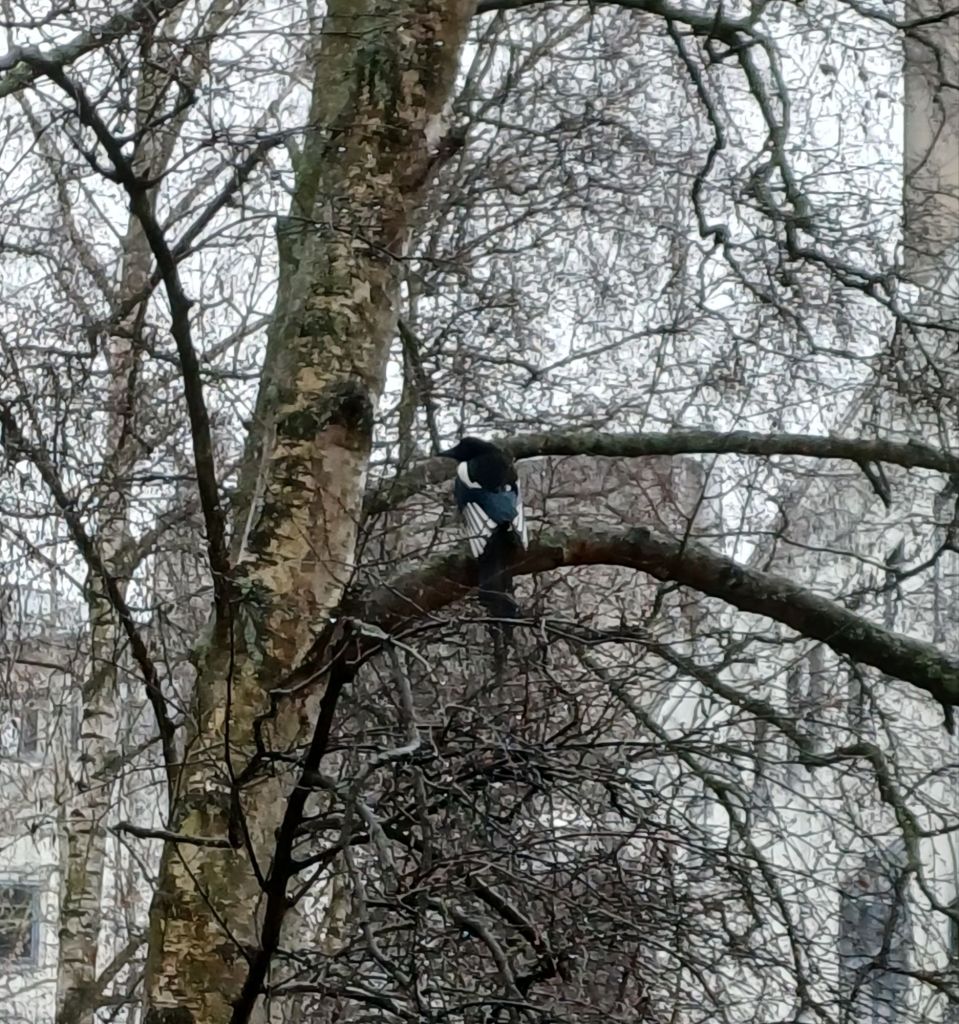
The Magpie is another common bird apart of the crow family found across the UK, apart from North Scotland, in many different habitats across the entire year, such as grasslands, heathland, farmland, coasts, woodland, towns and gardens. On average, these birds live for 5 years and are up to 50cm in length and have a wingspan of 56cm. Magpies are easily identified with their long tail, mainly black feathers, with a white belly, blue tints on their wings and a green tint on their tails (The Wildlife Trust, ND). Magpies are classified as green under the Birds of Conservation Concern and are protected in the UK under the Wildlife and Countryside Act, 1981 (The Wildlife Trust, ND).
Magpies are omnivorous, which means they eat both plant and animal matter, they tend to eat insects, small mammals, bird eggs and young, worms, berries, grains and nuts, this is one of the reasons they are often labelled as scavengers.
They tend to mate for life, with the male courting the female by rapidly raising and lowering their head feathers and opening their tails whilst calling in a softer tone to usual. They begin breeding in early spring, with their nests being a bulky cup-shape made of sticks, mud, plants and hair. Female magpies tend to lay 5-8 eggs and then incubates them alone for up to 18 days, but once they are hatched, both the female and male magpie will look after the young (Ark Wildlife, 2024).
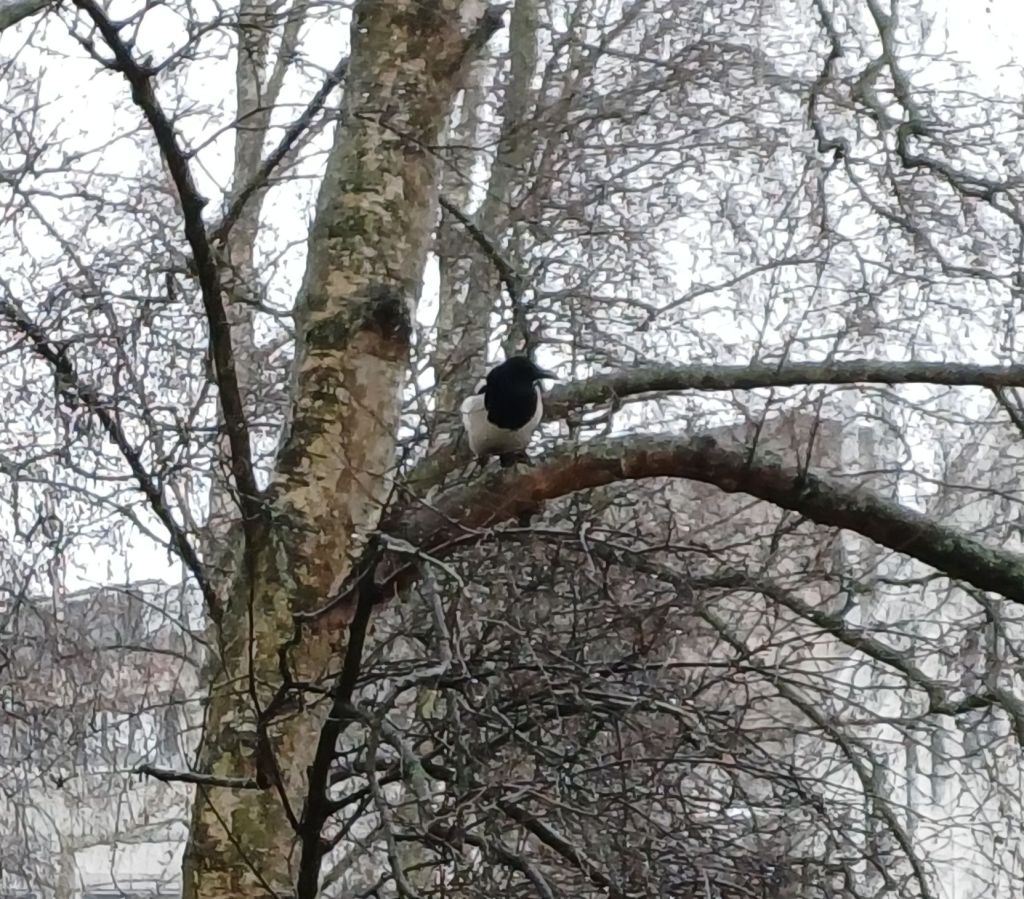
The magpie is considered one of the most intelligent bird species, through their brain-to-body ratio and using their own experience to predict behaviours of others. Their intelligence is also demonstrated with how they interact with other members of their species, with them being able to play games with each other, work in teams and even grieve another magpie when they die, and even going through ‘rituals’ for the bird that passed (Hogeback. J, 2025). They have also been studied, and have been seen to pass an experiment called the ‘mirror test’, where the magpie can recognise itself in a reflection.
Within folklore, Magpie are seen to provide good luck when greeted, as well as having superstitious meaning surrounding them, with one representing sorrow, two for joy and so on (The Wildlife Trust, ND). Magpies were also seen as symbols of intelligence and good fortune, as Romans admired them for their intelligence. Yet others, such as Christians, saw magpies as being evil, as they thought it was the only bird not to mourn the crucifixion of Jesus. As well as this, Christians believed that they carry a drop of the devils blood on their tongue, so if it was cut, they would be able to talk like a human (Vine House Farm, 2025). Magpies were also thought to have refused to enter Noah’s Ark, instead they were thought to gave preferred to stay on the roof and ‘swear’ for the journey (The Wildlife Trust, ND).
References
Ark Wildlife. “British Magpie Habitat, Food & Identification.” Ark Wildlife, Ark Wildlife, 6 Mar. 2024, http://www.arkwildlife.co.uk/blogs/wildlife-guides/magpie-identification-habitat-food. Accessed 9 Feb. 2026.
Hogeback, Jonathan . “Eurasian Magpie: A True Bird Brain.” Encyclopedia Britannica, 13 June 2025, http://www.britannica.com/story/eurasian-magpie-a-true-bird-brain. Accessed 9 Feb. 2026.
The Wildlife Trusts. “Magpie | the Wildlife Trusts.” Www.wildlifetrusts.org, http://www.wildlifetrusts.org/wildlife-explorer/birds/crows-and-shrikes/magpie. Accessed 8 Feb. 2026.
Vine House Farm. “Vine House Farm.” Vine House Farm, 10 Sept. 2025, http://www.vinehousefarm.co.uk/facts-myths-and-folklore-about-magpies. Accessed 9 Feb. 2026.
Wikipedia Contributors. “Eurasian Magpie.” Wikipedia, Wikimedia Foundation, 16 Mar. 2019, en.wikipedia.org/wiki/Eurasian_Magpie. Accessed 9 Feb. 2026.
 Jorja's Ecology Blog
Leave a comment